Hello,
I’m new to the community.
Got to find out about pixel-stripes while building this installation (video).
Since I come from Video-Mapping, I drive the installation with a VJ-Software. Can be seen here: https://vimeo.com/149521440
Now I’m about to design “Wifi-Slave-Controllers” and easy connectors to built temporary installations without hussle with the wiring. Hope I can get some tips here. (Looking forward to the amazing improve of FastLed on esp8266)
Already a big Thank You to everyone!
Since I’m more interested in the Light-Design, it’s great to have so many people share their knowledge about the technics!
Cheers,
Birk. https://vimeo.com/149517674
Welcome and nice to have you here @Birk_Schmithusen ! Imagine all this nice animations would be really sound-responsive… Come arround and I´ll show you something. It was a pleasure and inspiration to talk with you today!
Since you have basically everything Teensy-controlled it’s a little step to get get rid of the computer and instead programm the Teensy(s) directely - and use a sexy interface to control the Teensy.
I’d love to have a combination. I still like the video-mapping aproach, that makes use of the position of the pixel in the room.
I guess to have the video’s function like a “background” and sound-responsive code on the teensy, controlled via dmx from a light-controller for “effects” would be a good combination…
I think it’s possible to receive a “video stream” and calculate some other real time animation at the same time. If you’re happy with your 20-30 fps there is plenty of time to do other stuff.
@Birk_Schmithusen welcome to the community. Your work is fantastic!
If it turns out that the ESP8266 has not enough power for larger installations it still could be used as serial interface for a Teensy (the choice of most here).
Found an interesting tutorial
Thank you @Juergen_Buergin . Yes, to get some proof of concept facts about ESP8266 would be great: Is it able to drive 300 Leds (5m 60Led/m) would be an important question to me.
Thanks for the tip @Stefan_Petrick , but the FadeCandy can just drive 64 Led’s per Output. Since I want to drive at least 300 led’s per Output it’s no option for me.
And also with the calculation overhead needed to receive an Array of bytes over wifi from my “host”-computer?
That shouldn’t need any RAM but the processor, right?
wow, that’s amazing @Juergen_Bruegl ! Great work.
Do you use the Huzzah just to have the ESP8266 programme-friendly and bread-board compatible, or is there any level-shifting going on as well?
Since I’m aiming a bunch of “wifi-slave-controllers” it will make a different, whether I spend 3$ or 10$ for the board.
Would be wonderful, when you get WiFi functionality working and share the code!
My ESP8266 just arrived today and I want to test it, too
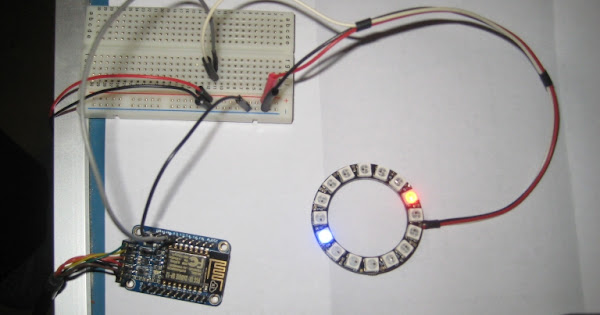
Got a few ESP8266 derivates. Huzzah’s does only level shifting on the reset pin, the GPIOs are 3.3V and NOT 5V save, 12mA max.
The voltage regulator has up to 12V input range and 500mA. The Huzzah is EC and FCC certified, means it has less interference to other electronics.
The ESP8266 draws up to 250mA and assuming you already got your 5V for the LED strips you need on the cheaper versions a step-down regulator e.g. this one: for 3$
Alternatively you can use a LM1117, but add caps, stripboard and headers you are back on 3$
For programming you need a FTDI cable or adapter. CAUTION: Some 3.3V FTDI cables have 5V on the Vcc line what will destroy your module !
Always check first the voltage !!!
Hope I get a grip on Android UDP programming - that is my weakness