My aim is a printer with larger than usual volume, that can print at higher than usual speed. Often trying things I do not expect to work … to see if they might.
Ordered 500mm sticks of 2020 extrusion, even though I suspected that profile might be a bit light.
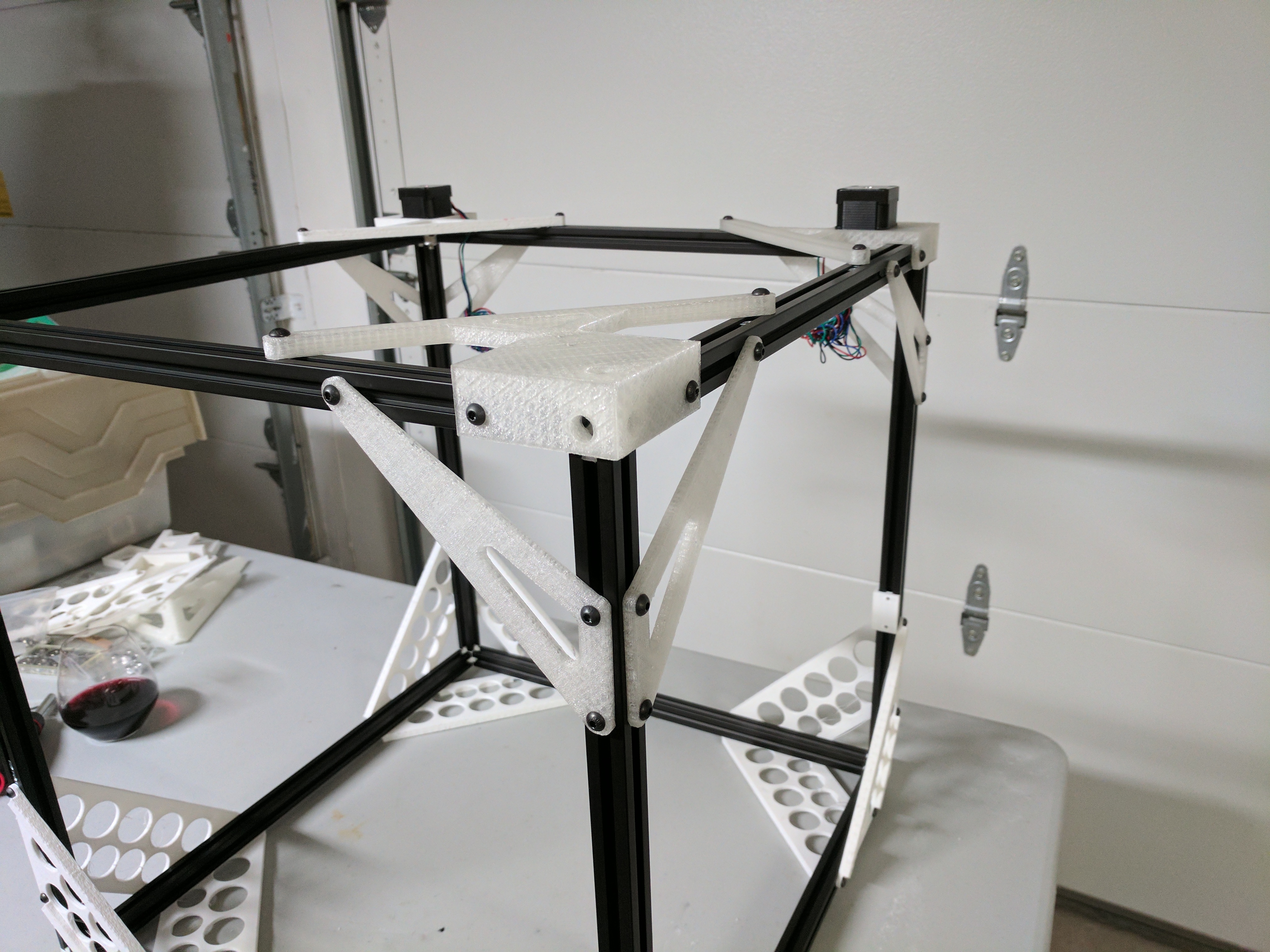
Printed PLA cubes to join the ends of the extrusions, though I was not at all certain they would be sufficient. On trial … they are better than I expected.
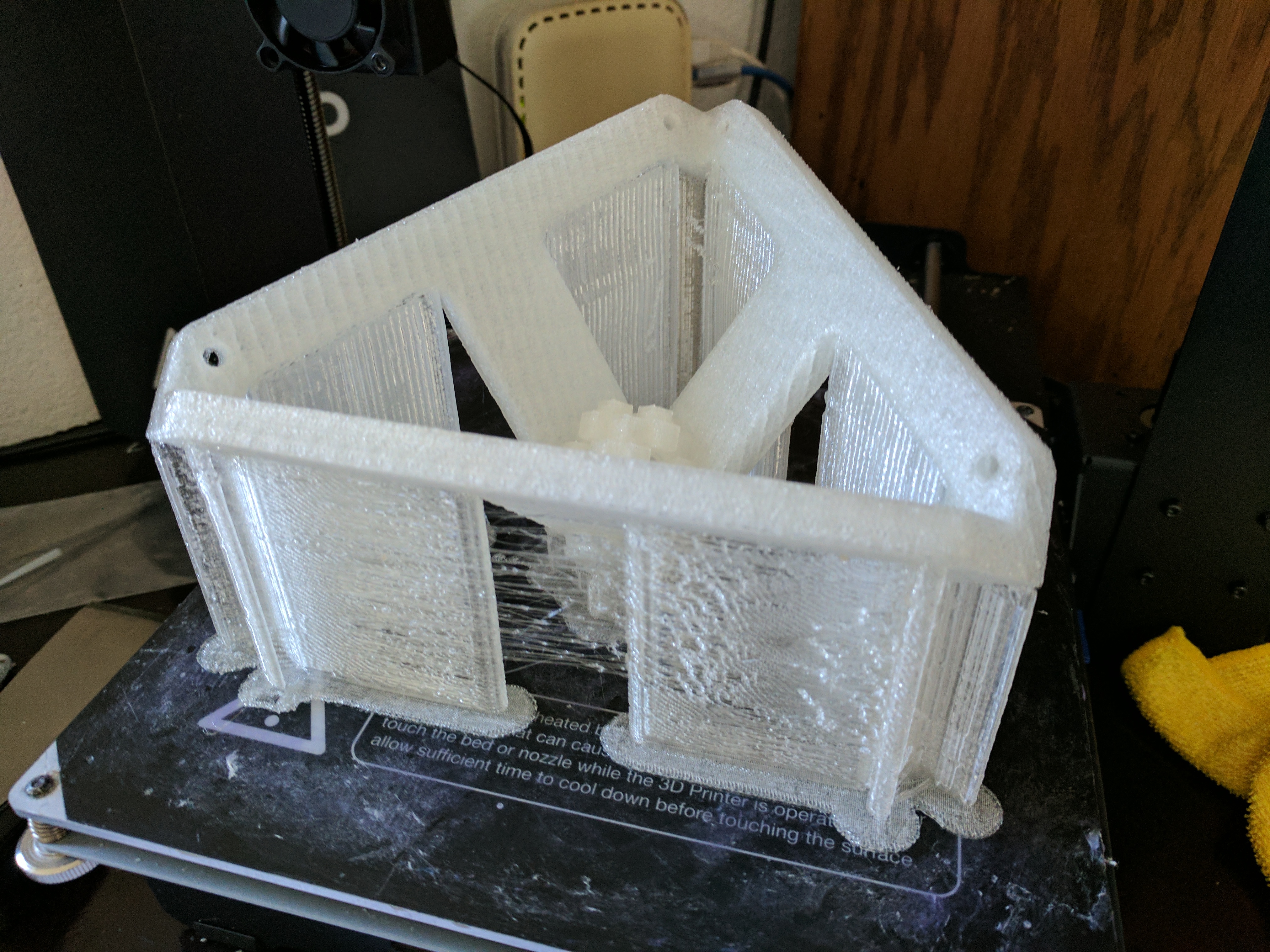
Integrated the cubes into larger corner braces, and … this all seems to work rather well. Tight tolerances mean these corners need a solid whack to snap into place … but not excess force. Once in place, my low-tech truing jig reports everything is square. Are these (mostly) one-piece corners (when 3D printed) sufficient to ensure the frame is square?
Whacking the frame from various orientations, the upper square (extremely critical) seems quite solid. The metal/plastic interfaces seem to strongly damp higher frequency vibrations. The middle-beams unbraced in Z do act as a spring, and the structure seems to resonate around 100 Hz.
As i do intend to eventually enclose the print chamber, and if the rigid plane of the enclosure has the right attach points, that frame-resonance might not be of issue. Also the print bed assembly might serve as a better truing jig…
Didn’t want to harsh your buzz but the printed braces are a non starter. Ive tried it they take hours to print and are not strong enough. Making it from aluminum flatbar is going to take minutes and be much stronger.
@Michael_Scholtz Printed corner brackets alone are too weak, but the big triangular cross-bracing will help enormously.
@Preston_Bannister 500mm 2020 is ok for a cube frame as long as it’s braced well I probably wouldn’t go any longer than that though.
The angular accuracy concern with printed corner brackets is valid – you need to think about whether angle errors in the parent printer will be inherited by the child printer. It can be manageable but is a risk to consider.
Check also the QR concept with quadrap community here as well. No printed corner and very light and rigid.
You could probably order 580 mm beams to get a real 500 x 500 cm printer.
@Ryan_Carlyle Yes, as to the errors (or not) of the parent printer.
If the parent printer is accurate, it might just be possible to send out printed parts, and the guy assembling the printer might(!?) not have to check if the assembled frame is true.
If the printer used to produce the parts is questionable, some sort of truing jig is required.
Also a bit of recursive irony. If I get the larger printer working, I will be able to print out larger parts, improving stiffness and reducing the part count…
All corners printed and installed. The funky diagonal braces and standalone corner cubes are now all in the discard pile. The cube is rather nicely rigid, even though the corner braces are light prints (with 20% infill).

 I probably wouldn’t go any longer than that though.