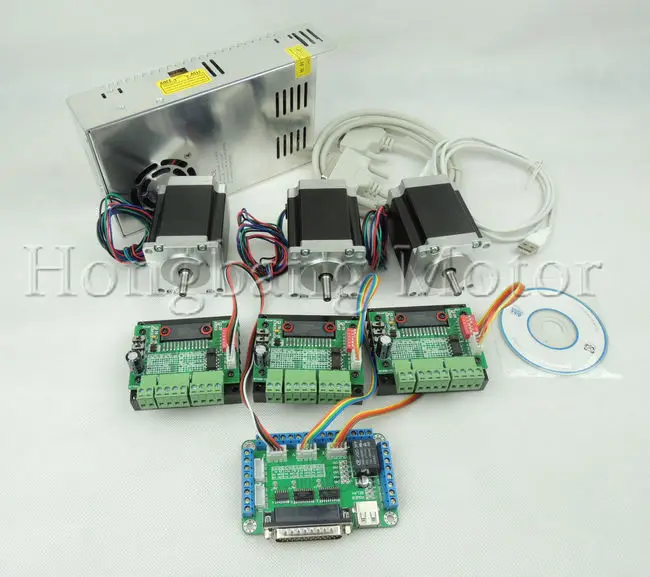
Ok I’m back in trouble again. Last night while working with my router, I heard a little pop and I got treated with the smell of burned electronics. I know that the stepper boards I used are cheap and temperamental.
My setup uses the following hardware.
• 1 x 24V/10A switching power supply
• 3 x 1 Axis TB6560 stepper motor driver
• 3 x 57HS76 3A 270 oz/in stepper motor
Model 57HS76
Number of phases 2-phase
Number of lines 4-wire
Phase voltage 3.08V
Phase current 3A
Resistence 1.1Ω
Inductance 3.6mH
Torque 1.89N.M(270 Oz-in)
Shaft Diameter 8mm
Axial length 21mm
Side length 57mm
High 76mm
Weight 1100g
+Peter van der Walt Last time you told me to get the wantai dq542ma is this still the best choice and is this card compatible with my system? Also is my setup compatible with a smoothie board and CNC web. @Paul_Frederick judging from your post, you seem to be satisfied with the TB6600 DC12-45V Two Phase Hybrid Stepper Motor Driver Controller. Is this one as good or better than the wantai dq542ma. I don’t think that I have enough knowledge to make an informed decision and treating stepper boards as consumables is getting a bit annoying
I have never used the wantai dq542ma, so I cannot say anything about it. I have not used my drives for very long either. But so far they seem great to me. There are certainly better drives out there though. Just probably not for the price.
I am only driving my drives at 32V, because that is what they say on the board. Although a real TB6600 should be able to handle higher voltage than that. Over voltage situations can damage stepper drives. The TB6560 was especially susceptible to that failure mode too.
When I ran TB6560s I never went over 28V. Just to keep them in a safe operating area. You only need to over volt for a moment, for a drive to blow. Another thing to really look out for is loose motor connections. Even the best drives can blow if a motor lead gets disconnected while you are running. That is due to back EMF, inductive kick back, whatever you want to call it. It is a drive killer.
I think I might have the fastest drawer slide CNC machine in the east right now? I ran my X axis up to 174 inches per minute, and it still did not stall out. At that point I was going way faster than I needed to, so I stopped testing. My TB6560 drives topped out at 116 IPM. They would stall after that. I have 10 TPI acme lead screws and HDPE lead nuts. At 174 IPM that threaded rod was just buzzing along. 1,740 RPM I suppose? Far faster than I planned on going when I built my machine.
I am perfectly satisfied with 90IPM rapids on my little machine. This is my secret weapon for performance http://blastercorp.com/Dry-Lube-with-Teflon Like the can says, Work it like a pro.
It amazes me that people buy TB6560’s. The TB6600 isn’t bad, but can be a little “twitchy” and needs to be tweaked into place. The DM542A are good, but make sure you get them from a reputable source… the crap from China is crap. If you want REAL power, get a geckodrive or one of my THB6064AH kits.
@James_Newton
my TB6600s are powerful enough for me. I only run them at 2 amps. I really don’t want to run over 1,000RPM on my drive line either. My TB6600s appear capable of going twice that fast. Though I only wound the one up to 1,740 RPM before I stopped that. I didn’t want to break anything. It seemed to have plenty of pull left in it to me when I quit.
I’m also only running at 32V input too. Because that is what is silkscreened on the boards I have. A real TB6600 should be able to handle 40V. I don’t know what makes my boards 32V max. Possibly counterfeit drive ICs? The filter caps on the drives look pretty craptacular to me too. I should change them out for something decent.
But right now they work, so, it works tends to make issues low priority with me. I’d rather make my own drives. Then I’d know all of the gory details about them. Well these days it can be tough to tell counterfeit chips from the real thing. It is only when they fail to meet some spec that you can really know. I’ve seen counterfeit ICs with nicer looking markings on them than the real thing. The bootleggers really go the extra distance today.