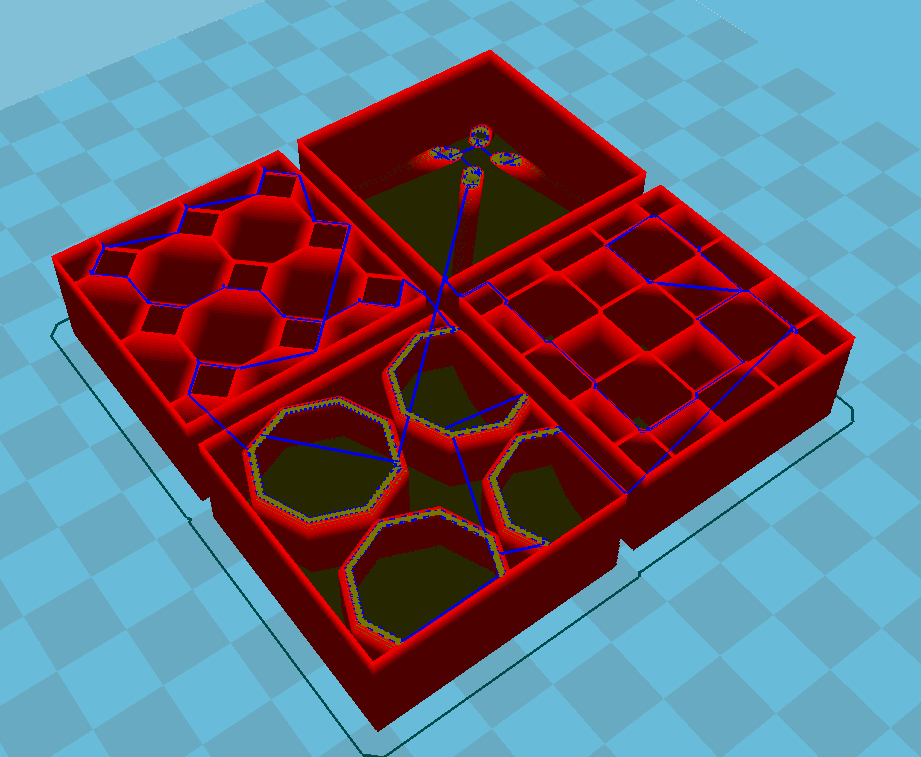
I have to share something very cool. A student by the name of Richard Tynan is entering a project in Ireland’s national science exhibition based on my “Thoughts on Fill Algorithms” blog post [http://garyhodgson.com/reprap/2012/01/thoughts-on-fill-algorithms/] (from 2 years ago - wow time flies!).
His work focuses on the the various cell tessellations available. He’s hitting some of the same problems I did in my initial testing, namely OpenSCAD doesn’t handle complex shapes very well, but he’s got so far as to create some example prints! Have a look at his thread on the RepRap Forum here: 3D Infill Algorithms, Experimenting
I still feel strongly that there is potential in more advanced fill techniques, and building a slicer to experiment further is still on my to-do list (and now moving upwards). It’s also about time I wrote up about my experiments in FRep!
I think that’s the big problem; the people who have tried this have been trying to model these features into parts via the 3d modeling process, and not the slicing process.
@Michael_Hohensee@ThantiK Originally I had tried to get my head around Skeinforge in order to be able to add new infill patterns, but this proved quite a challenge due to the architecture and coding style of Skeinforge (hence me attempting to simplify things in the (now completely out of date) https://github.com/garyhodgson/SkeinforgeEngine)
The problem with Slic3r for me is that it’s written in Perl (Alessandro is a Perl Wizard) and so the thought of having to relearn Perl turned me off completely.
The final option I had was to build a simplified slicer myself, and there I hit a wall finding the time and building up the knowledge on how to actually do it. If anyone has a how-to guide to slicing I would love to read it!
I also intentionally sidetracked myself by looking at the work of Functional Representation as a completely different means to building slicers - this resulted in http://garyhodgson.github.io/frep-csg.js which is only a toy/test tool though.
Someone on my thread mentioned that Daid is planning to modularise the Infill functionality in Cura - perhaps this might yield results.
Currently infill in Cura is done by sending a 2D polygon to a function which generates 2D lines in this. However, for advanced infills you would just need to build more advanced functions around this. I’m sure it could be done, and I’m willing to assist if someone wants to tackle this. (I have so many idea, and so little time)