This is my remixed and smaller version of #Ultimaker2. I call it #DINKY. #DINKY took me almost one year to finish. It has a size roughly the same as Ultimaker 2 Go, but with a larger build volume. (The actual build volume is 125 x 110 x 140 mm³, the overall size is 271 x 235 x 289). My goals were:
(1) to find out how compact a printer could be, namely being a fixed overall size, to maximize the build volume. Therefore DINKY has the ratio of (build volume)/(overall size)= 10.7%, compared with UM2Go, which has the ratio = 8.9%.
(2) to make the extrusion system changeable. Therefore DINKY has a separate XY motion system and a removable toolhead. To remove the toolhead, one only needs to unscrew two screws and disconnect the cable.
(3) keeps all the UM2 functions. Therefore DINKY have 90W heated bed, LED lighting, 4:1 gear extruder, Olsson block, 30W heater, two PT100s for heater and bed, 3.0mm bowden tube.
The whole design was done by myself. It was not as easy as it looks. To make DINKY more compact, I have to tweak things in 1 millimeter scale. The C-shape structure was inspired by #DICE. The shell was made by two layer acrylics, painted and glued together by myself. The finishing was very satisfied. I had a much smaller CNCed toolhead. The print quality is good! The printer was much quieter than my UM2 clone.
The future goal is to design more toolheads to fit this motion platform.
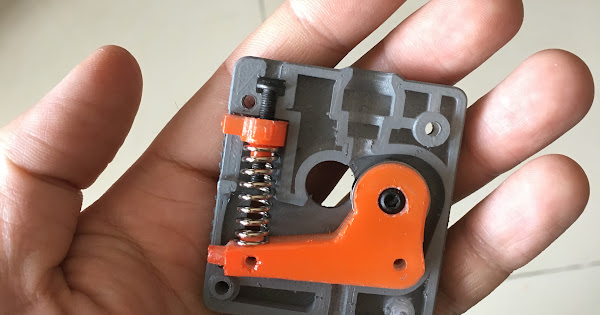
@Daid_Braam Good point! The feeder was really painful part for UM2. The weaknesses were two points I think: first the non-gear reduced stepper motor cannot provide enough torque and precision, second the knurled feeder wheel which often cause grinding and filament deforming. I tried to avoid these two points by using a 4:1 reduced motor very similar to the setup in UM2+, and a Hobbed feeder wheel. They actually works fine! And I do like the neat design of UM2 feeder, with adjustable tension and compact looking.
@Xiaojun_Liu the actual problem is that your knurled wheel will heat up, due to compression of the filament and heat from the motor. A gearbox helps a bit, but a metal gearbox will only delay this problem, not prevent it.
@Daid_Braam i guess POM gear would prevent heat from the motor in a um2+ like setup. For compression of the filament, I don’t know how much heat it produces.
Ultimaker seems set on knurled drive gears rather than toothed ones like everyone else uses. The knurled wheels have the advantage that they don’t hold plastic shavings and thus never need cleaning, but they don’t grip nearly as well, and tests have shown that their steps/mm value changes drastically with extrusion speed/back-pressure, resulting in tooth marks that get much closer together.
Ultimaker also seems set on 3mm filament, even though most of the drawbacks of bowden extruders (other than their problems with flexibles, of course) seem to be significantly reduced by using 1.75mm filament.
Ultimaker also seems set on 3mm filament, even though most of the drawbacks of bowden extruders (other than their problems with flexibles, of course) seem to be significantly reduced by using 1.75mm filament.
There is the general consensus in UM R&D is that we should have switched to 1.75 from a technical stand point. It’s just the double supply chain that is the problem.
@David_Sexton Sorry for my late reply. Since it was a test-prove-modify procedure, I spend a lot of money on some parts might be unsuitable/unuseful later. Also I live in China so things might be much cheaper than anywhere else (such as CNC costs, bearings, main boards, etc.) . But I’ve added up my cost. The total cost for making one of these might be around 3,500 RMB in China, which is $524. Of course the price for failed parts and redundancies are also included in this evaluation. So the final price should be even cheaper