So, I am trying to find a good inexpensive 5v power supply that can handle a good number of ws2812s. I like adafruit’s 10A adapter (25$), but I am looking around to find a less pricy – but still reliable – option.
I think my project could do just fine on 5-6A, and the supply must be either a wall wart or other fully enclosed small option, no bare metal boxy power supplies will work.
You aren’t going to see more than 3-4A off of a wall wart in my experience, and the cheaper 6-10A power supplies I’ve gotten off of amazon often can’t push the number of amps that they claim or they simply fail.
Don’t skimp on the power supply, doing so, in my experience just bites you. (Then you’re buying another supply and spending more than if you had gotten better up front)
I’m cheap and a newbie to electronics, but could something like a laptop power supply be hacked to meet your requirements? I see you can get 65w for 19.5v and 3 to 4 amps…surely the amps can increase with less voltage using a divider and heavier wiring. This is pricing for a new one, but shop at local thrift store for similar at much cheaper. http://www.laptopchargerfactory.com/dell-inspiron-laptop-charger/inspiron-15z
You could use 2 smaller supplies BUT make sure you connect the grounds and NOT the '+5V together. Power supplies differ in voltage and can back-feed among each other.
Conntect the '+5V lines to individual strips or pairs.
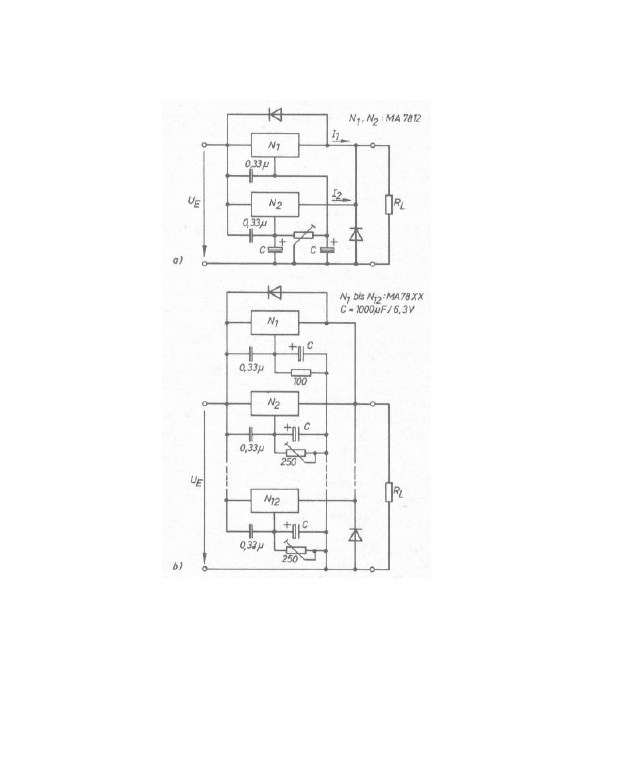
A LM7805 can take up to 1A (heavily cooled at high input voltage). Simply connecting them in parallel doesn’t work either because of the back-feed problem.
For the ones who need to use them (in a smaller project) here is a circuit that works:
@Juergen_Bruegl
I was just starting the conversation with my suggestion, my hypothesis. Thank you for engaging in this design…I enjoy learning something new daily hourly.
Then, I thought about it, and I will stand with my suggestion to meet the requirement(s) of the project. The only difference is the size I chose is 15w more than the given 50w; there is a reason for this selection, it is common size and very cheap…not all the watts will be used unless the load is present. So in theory, I have planed ahead for expanding the project. There should be over design in all projects for safety and better efficacy. This is my experience on a much larger scale…I’m just applying it to this small scale project.
So I got to thinking about the laptop power supply…and thought how to go about hacking it…and this is the approach I would practice and follow, published Nov_2014: Modifying a notebook power supply https://hackaday.io/project/3469-modifying-a-notebook-power-supply
I would not recommend combining power supplies…what I understand suggested was dividing the project into branches…and this may not be a part of the plan. I have yet to see a design combining power supplies for basic electronics; it is very dangerous.
My suggestion was NOT to devide the project in branches. Data and ground are shared by all strips.
Just run the '+5V lines to different strips.
Implications: one strip might run on 5.3V, another on 5.1V, another on 4.9V. The APA102s have an internal voltage regulator that keeps the driving voltage at 4.5V. In a nutshell: one strip will get a little warmer than the other and maybe almost un-noticable brighter. To avoid this use individual max_brightness settings.
The Hackaday project is really dangerous. It is fine if you modify it in a few-volts range, but from 19.5 down to 5V is huge!
Keep in mind that powersupplies are a highly price sensitive subject from manufacturing point of view and they are designing them to the bare minimum specs. We are talking here about cost savings in the area of Cent-fractions! There is zero headroom in the design.
What happens when you scale down the output by 75%? You won’t get higher amps as specified at nominal voltage because the wires of the coils, traces, and supply lines might burn out.
It has to switch 4x more to keep the voltage at 5V - you’ll get serious voltage ripple problems and need to improve the caps.
When the thing overheats and the opto coupler stays open - your voltage will rise well above 20V and you have destroyed a lot more $$ on the LED side as you could have ever saved your power supply.
Please take @Daniel_Garcia 's advice and don’t save at the wrong end.
Still using old PC power supplies here. They’re switching, so they only use the watts you need (+ 20%'ish). And if the 5v lines aren’t enough wattage, you can just use a RC type ubec or two on the 12v rails… Cheap/reliable…
@Andrew_Tuline I’d rather not use the bricks because they burn max watts contentiously, regardless of the load. Granted, these LED’s aren’t used for lighting mostly, but I see people using bricks to power LED lighting that they installed to save on their power bill. Which is kind of moronic when you think about it… ;p That one will burn 10 watts 24/7 so long as it’s plugged in…
@Andrew_Tuline I like that one. Which is why I like the old PC supplies. They seem to last forever, and come in all physical sizes and shapes. Plus they can be had for a song on ebay. But that is a good price if it holds up…
So, these are all good ideas. I am looking for something that is 5v standalone, so stepping down a larger voltage (like a laptop supply or a 12v brick/wart) is not going to work for this project. It also needs to be repeatable, so hunting down PC power supplies one by one isn’t really going to work here either, and besides, this needs to be self-contained and small.
@Andrew_Tuline , have you gotten one of those and used it? I’m hoping to find a recommendation from someone who actually had one in use and has real data about its reliability.
@Daniel_Garcia , I completely agree about not cheaping out on power. I’ve had projects get thoroughly wrecked by a power supply that failed catastrophically. That being said, Adafruit is never the best price on just about anything (see neopixels, etc), so I figured someone out there has them beat… I just can’t seem to find it. Adafruit shows the part number clearly, but searching directly for it yields no good results either so far.
@Mike_Thornbury , that is a great unit, I particularly like the 2-year warranty. It is a bit too (physically) big for my current project, but I’ll keep it in mind for future builds. Thanks!
Really? it’s like about 3.5 inches square. Maybe if you were more forthcoming about what you were building, how many LEDs, how you need to package it, you would get more help.