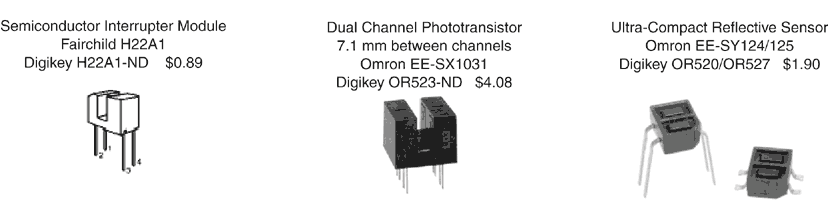
What’s the repeat-ability of those optical IR sensors that are prolific throughout printers/copiers? Good enough to use instead of the metalic proximity sensors that are currently popular?
(http://thedenneys.org/pub/robot/encoders/sensor-types.gif)
I have 2 types - ones in which a blade brakes the beam (this would require physical contact with the bed and some kind of repeatable device to position and retract it) and another kind where both emitter and detector face the same way and detect a reflection (suspect these would be affected by ambient light, etc).
I print on acrylic / glass. Nothing for the metal sensors to detect. So I’m still in the dark ages with a momentary toggle switch on the side triggered by an adjustable bolt.
Thoughts, ideas?
I know that a lot of pick and place machines use those optical sensors for zeroing the Z. Not sure how repeatable it is with a retracting arm though.
According to @Brook_Drumm copper tape on the bed over the autolevel probe points works well. I am going to try it with aluminum duct tape when I get the glass holders made for my simple
Yeah, but then the tape imprints on the bottom of the print / gets lifted off, etc.
Besides the inductive probe I got with my kit appears to be defective - the LED works, but the current/voltage on the probe line is too low for the board to detect it, so I’m looking at alternatives.
Understood (btw, the metal sensor/proximity probe is also a 3 wire setup).
How about your break beam one on the left and a click pen? A black painted section of click pen could probably trigger it.
I am using such an optical barrier (not the reflective type) for the Z probe and measuring with a dial indicatorI can say that the repetability is around 0.02mm or even better. It also depends on the quality and the component and the size of the barrier window. I have a metal probe that touches the bed and it breaks the barrier when probing. A servo is lifting the metal probe when finishing probing.
I could not be more happy with it !
I’m currently trying to not rule out whether to touch the bed or not, just looking for options other than detecting metal.
@David_Sherwood the thought of doubling up the hot end as the probe is very interesting. It’s similar to how my pcb mill works (the milling tip is the probe for mapping the bare pcb surface).
I designed one of those and measured the repeatability to be sub-micron. Or greater than the accuracy of our stage. Typical numbers I hear is 20 microns. They work great for endstops
Hmmm…if they are that great for endstops, I hope printers start using them instead of mechanical switches. There is less to break that way. Seriously, if you misconfigure a printer’s endstop signals once, you may end up breaking your mechanical switches.
I think you’ll be hard pressed to change much. Typically they’re more expensive and with mechanical endstops you still get ~50 microns of repeatability. Which is plenty good for a 3D printers home sensor.